Category: philosophy

A meditation on Death

wpid-20150913_101016.jpg

Every town dweller maintains an oasis. A patch of grass, green plants; a garden. This is an unconscious ritual of hope. There is a desert a few hundred kilometres away to the East. The sea is 5 kilometres away to the west. Brutal summer heat sucks everything dry and twice a week, we fight back with water. It is an endless cycle. It is an apt metaphor for the short lives we live on a fast moving rock that turns on itself whilst circling a star that is dying a slow and glorious death.

We love and, if we are lucky, are loved back. A welcome parenthesis in the absurd text of our lives, If we are fortunate, is the gift of children. If they remain happy and healthy then we are doubly blessed. At some point the people we love begin to die and the grief caused by their leaving either draws us closer to the faith of our choice or illuminates the absurdity of the condition of being alive. Perhaps both? I live in a constant state of mourning. Acutely aware of the imminent demise of everyone, I feel in all moments the loss of those with whom I am walking on the beach, for whom I make a cup of tea, with whom I look up at the sky and draw from the stacks of cumulus some shape or face or meaning. I live with the pain of loss even when nothing is lost. I anticipate pain the way swallows anticipate rain. There is a joy and a heavy grief in seeing the quick dives and low sweeps of these delicate birds. Some are drawn to the sea whose constant rows of falling froth laugh at the littleness of our human fear of endings. I am all endings says the sea. I end all of the time and look at me, see how large I am and with what force I end. Then our own ending seems alright and even normal, usual.

wpid-wp-1426734135092.jpeg

Against the violent current of nihilism I water the grass, the plants or dig a hole and place into it something alive in the hope that it will grow after I am dead. Hope is difficult. Putting a foot onto the floor and then the other is sometimes the most positivity I can bring to a day. Yet, I do not consider myself a negative person. Beyond the front door I am all smiles and mischief. The ones I love bare the brunt of my contradictory nature. My home is the birthplace of my being and I am not yet fully formed. It is here that I may express my disgust at the absurdity of human existence. Here that I hate people and love my dogs; despise the world and love my wife and children. I will love and hate with passion. I empty the glass of my being so that I am able to go out into my classroom and teach empathy and compassion. I can do this because I need it most and because I hate my self at times and people and the condition of life does not mean that I hate my self or life or the condition of being alive.

I am establishing limits. I will no longer entertain the simple minded. Those who elevate dogma of any brand above simple humanity. I cannot entertain such nihilistic stupidity. My brand of nihilism is entirely different. I marvel at the infinite dance of atoms whose rhythm gave rise to me. I am in awe of night skies and ants and feel the cosmos reshuffle itself in the dying twitches of a bee on a windowsill. I am grateful, to the deepest recess of consciousness, for my life and the ones in it that I love. I am also mindful of the incessant grief that marks the boundary of my existence. I will not accept this without some act of rage. Doesn’t my rage against the absurdity of life confirm my deep attachment to it? I find living to be a precious and beautiful event. I am just pissed off at a very deep level that it must end. If one’s finger bleeds at finding a thorn on the stem of a rose, one does not assume the rose hates you. The pain is an anomaly I am still attempting to understand.

I was entranced by a bullfight I watched in Madrid one Sunday afternoon at Easter. It was a manifestation of my conflicted being; the personality of soul on display. Ten minutes is all it takes to represent life. Our wilful pride swells as we swagger boldly and well dressed into the world silently crying out “look at me, look at me! Am I not the finest thing that ever lived? Am I not splendid? There in the prime of our lovely and beautiful naiveté we say to ourselves ‘but this is easy. Why did our parents and their old friends warn us about life? It is not hard at all. It is marvellously simple and I am so grand.’ Then from nowhere a bull is unleashed and it is not just there it is heaving and powerful and wants to dig its horns into you. My God, something wants me dead! How can that be? I am too pretty and young and wonderful to die? Then there is the battle and this beast that is as beautiful as you must die, or you will die. Life becomes in a moment not the style of your walk or the angle of your smile at admirers; it is simply that if you do not choose an action you will die. Something always dies at the end of it. At least once it will be you. Until then we must learn to not be so arrogant, to understand that everyone is beautiful and that everyone has their bull.

IMG_2622
By Mike Scallan
Suburban Blues


Suburbia is the purgatory of modern development. It is neither nature nor city but straddles the space between. Here, people are frenzied shoppers   but are also desperate to escape the compulsion to consume. Once people lived in harmony with nature. Seasons guided our notion of time, objects were made and ownership was a foreign concept. It’s a life I romantically imagine I live when I trek through or camp in isolated places where there are more trees than people. Now we own stuff or pursue stuff and are surrounded by busy people constructing, selling, buying or breaking. There are trees in suburbia but it is very peopled, busy and seems to lack something, or so I thought.

wpid-dsc_0768.jpg

My life is surrounded by objects which constantly threaten to own me. Maybe they do? They hold memories of my life in the way the landscape holds the lives of people living on it. I do not live on ‘the’ land. I live on a square of mortgaged real estate. I have made my peace with that. I respect it by caring for it. I bring beauty into it. I plant flowers, fruit trees and bottle my own olives. Inside my many walled dwelling I place objects that I have purchased. This is my ritual. I may not feel a cool breeze around an evening fire or wake up damp to birdsong, but if you look carefully it’s a rich place. Suburbia suggests the universal trend towards bland sameness, a middle class lego land. It’s more than that. It’s the space on this earth  where I live my life, find meaning and  constantly re-imagine existence.

wpid-img_20150122_142436.jpg

Here is a part of a shadow cast by one of the objects of my life. But this steel chair doesn’t cast shadows here anymore, or anywhere else now because I threw it out. I rebelled against the voice of my father which has always gently cautioned me to never ‘throw away’. I shut my ears, my heart and shouldered my way through the memories imbedded in the rusty seat. Where the rust had swollen the joins I bent the chair in half and tossed it away. There were waves of guilt as I surrendered to the consumer mind – “I will buy another, a newer and better chair”. Then I did. It was easy. It was difficult. Nostalgia bit at me as yet another object that had migrated 6000km with me gave in and got chucked like it was just a thing-which it is, was.

The white wrought iron chair was a part of a set of three objects: A table and two chairs. Meals were had around it where we encountered some of the best words we had to offer each other. The salted coastal air eroded the table first, then the chairs. They went from holding us to the rubbish dump too quickly.

20140324_081613

I must avoid being too bleak. Hope must be maintained. A life endured, even enjoyed, has a duty to look beyond current erosion. We must point our children to new experiences, to look beyond the rubble that gathers around a life. We all crumble,to varying degrees. Consumerism has its place, but objects carry history. We simply carry on.

Now we have two new chairs beside a table made of steel to endure the coastal air. I’m still not sure of the difference between steel and iron, I did once but I forget and maybe it’s not important. One kind lasts longer but neither lasts long enough. I wonder if whoever throws these out will at least pause before discarding them?

Meanwhile, new experiences open like blooms and a fresh beginning unfolds in suburbia. Ultimately, what will remain here? The trees I planted, some plants I grew from seedlings, a few paving blocks perhaps?  Maybe not? Suburbia is a battlefield between relentless, brutal  progress on the one hand and the lives of people held in fragile ceramic pots and weathered patio sets on the other. Thankfully the beauty of nature is there as well, if you look for it. Like us, it’s just somewhat contained.

wpid-20150913_100942.jpg

By Mike Scallan

Ode to a moth

Ode to a moth

Quiet as brick and effortless as breath you slipped your soft form and went, leaving just this delicate presence that rocks a little from my own exhilation.

Did you suffer? Do moths suffer as people do? Was your leaving as tranquil as your slack wings suggest? We’re not all that different you know, our species. Yours and mine both seek out light and finally settle unnoticed in the shadows. Here, looking at you on this ledge, in this public toilet, your mausoleum, I offer a few minutes of silence. Dead quiet. Did you try to enter this light bulb? Did moths live longer before electricity? Chasing the sun is easier than gate-crashing closer light. It takes longest to see what is closest to you.

I’m not in the habit of talking to dead insects, that would be absurd. Perhaps whenever we talk into an absence, we are really just talking to ourselves and maybe real people we knew who are now also on the edge of our memories, our world. Death reminds us that life existed where it no longer does. A brutal irony.

It is the brevity of life that gives it some worth but also bridles the heart with such unbearable pain. Maybe that is why I’m having this conversation with you? If I cannot pause for you, what will I stop for? If the stuff that once bound us, life, goes out of something little, surely it’s as sad as when it leaves the larger among us? My life is as little as yours in the context of the world. We may even be brothers? There is vast chasm between your world and mine. There is language for one thing, I do not know yours. But, whatever the differences my friend, we depended on air together. The only real difference is that I still breathe and you are simply still.

wpid-wp-1444829010425.jpg

I own therefore I am

I am on my way home, in my car, listening to my radio, I stop at our beach. We call it ours, this stretch of sand on this continent that is now my home. My country, this is how I refer to the 7,682,300.0 square kilometres beneath my feet. I have a passport which confirms my citizenship of the state. It is navy, embossed in gold, official looking. The cover is bendable but thick. It will not easily be damaged from frequent use. It holds the allure of adventure. This is how the institution of state draws us in and places the spell of attachment on us. “With us you may travel freely, ” it seems to say, “you are not the citizen of the world you imagined you were. You are not as free as you thought you were. This book marks that you are owned. We call this state of being owned ‘citizenship’.”  

It contains, inside, a black and white photograph of me, unsmiling. One is not encouraged to smile for official photographs. So here I am in my country seriously wishing to understand how I assume that so much is mine. I have even purchased a piece of land with a house on it and that I call mine but really, it is the bank that has deemed me fit to speak of it thus. I earn a salary, paid fortnightly. Most of this goes to the bank so that I can one day, decades from now, call the house truthfully, mine. Strange isn’t it? To speak of it seems strange, this suburban ritual of possession. I am told that it was not always so. I have read articles by clever men on the history of ownership and possession and it would appear that Indigenous people worldwide never considered themselves owners of land. My mate Matt, a Noongar man, once laughed off the notion of buying a home. “Why would I buy dirt cobber?” he asked me. Indeed, why?

wpid-img_20151024_185116.jpg

It seems to be a distinctly European invention, this idea that ownership begets identity. We assume it has always been so, genetic even, like violence. Seems we have been wrong about many things. They really started something those restless fifteenth century Spaniards and Portuguese. Further back the Goths, the Vandals, the Huns, the Persians, the Greeks, the Romans and the Vikings caught it; this contagion of land-greed. Their desire to possess was passed on to the English, the Germans, the Belgians, the French, the Dutch and the Italians. What formed their view of the world? Why did they think a first meeting ought to be followed by the planting of their flags, declarations of ownership and brutal oppression? It’s a fundamentally flawed human practice that we continue to emulate 500 years later.

Where does this language of ownership came from? How did it come to be the mode of my tongue, my mind? The pronoun ‘mine’ is one of a child’s earliest words. It defines the boundaries of their existence: ‘my nose’, ‘my mummy’, ‘my house ‘. What does it mean to ‘have‘? How do I ‘have’ this home, ‘have’ this toothache, ‘have’ this bruise, ‘have’ these thoughts? In the marriage union I get to ‘have’ and to ‘hold’. I have a great deal, but when was I bestowed ownership of ‘my’ character? Who is this ‘me’ I speak of?

wpid-dsc_0597.jpg

Studies of human society suggest that one of the prime forces in our history is ownership. We have evolved through ownership. From feudalism to mass consumerism we have organised our social structures around competition for land and artefacts. We call land ‘real estate’. It forms our reality. Being landless thus presents itself as a an ‘unreal’ condition, an undesirable state of being. Material poverty is perhaps more an indictment on our modern tendency to insulate ourselves with our possessions. Poverty represents the way we think about the world, not a way of the world. It is perhaps more a consquence than a condition. It is a word denoting what one does not have. A street vendor in Mumbai, India told me there was no poverty in India. I did not understand what he meant. It appeared self-evident to me that poverty was not only real but rampant as well. I’m beginning to realise what he meant. I’m seeing more of it living in the first world.

wp-1449482047629.jpg

Learning not to fly

image

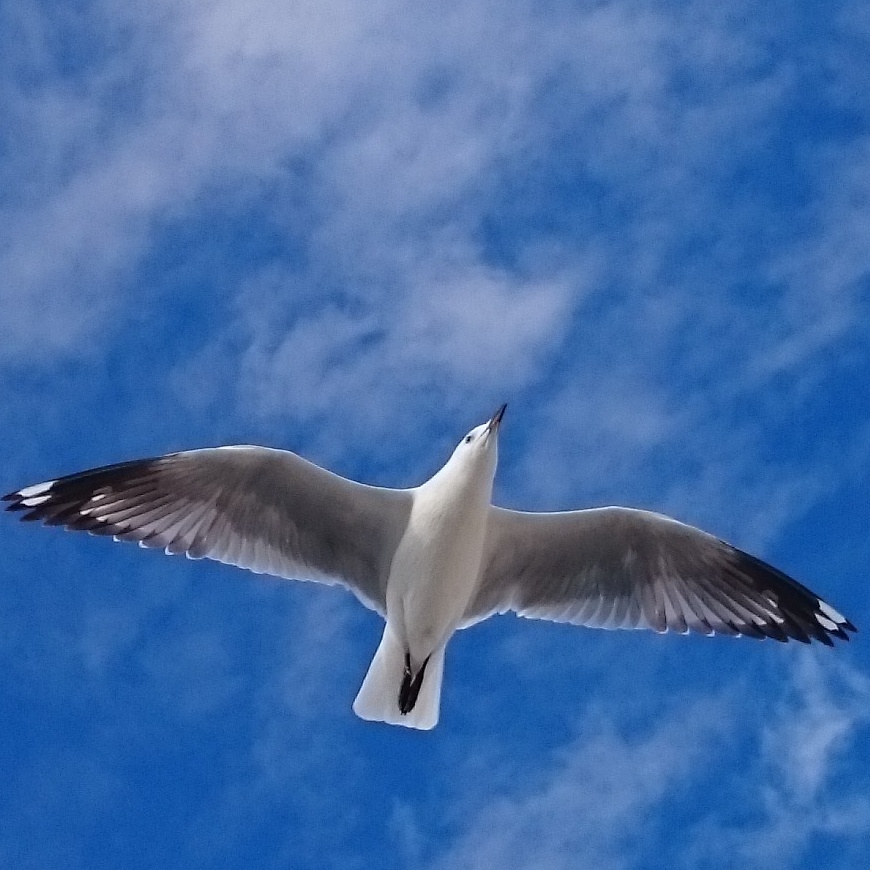
It is the swift overhead passing of a seagull which suggests to me that my fascination with flight is not that I yearn to fly but that I wish to escape completely my inner demons. My fallen angels of idealism. My automated days of work, of incessant calculations of the infinite responses to the interminable thread of responsibilities that seem to govern my existence.
I realise that the moments of peace I chase after are forever just moments. I will never stretch them out to anything more than a moment. The most I can hope for is a more expansive heart so that these moments fill up more of the empty space inside me.

The desire to fly is the breath of weariness. It is the tired exhalation that leaves my body as I understand that I am living the life I have, not the one I imagined I would live. In that life I am wiser,  writing text widely read, creating art with words and paint and clay. And people buy my work which allows me to do it again and again.
However with this understanding there is also,for the first time perhaps, the knowing that the life I have could not be better for it contains the people I love. And love is more important than words or paint or clay. The real art of my life has been surviving my mistakes.

image

Besides, relieved of the ghastly responsibility of having to create art,  I can write without hindrance,  with honesty. I can experience days of trudge knowing that most people feel the same way. I can drag myself to work and once there realise I actually enjoy it. I can, like everyone else, hanker after freedom from  responsibility. And yet, it is that same responsibility that allows me to look up at a seagull and see its beauty.

I imagine there must be at least one seagull out there who looks down and imagines how fine it would be to walk every day on the earth.

wpid-img_20150122_141733.jpg

Posted from WordPress for Android

Questions with no answers

image

“Indeed, the only truly serious questions are ones that even a child can formulate. Only the most naive of questions are truly serious. They are the questions with no answers. A question with no answer is a barrier that cannot be breached. In other words, it is questions with no answers that set the limit of human possibilities, describe the boundaries of human existence.” – Milan Kundera, The Unbearable Lightness of Being.

Posted from WordPress for Android

‘Freedom of expression’ – the word game.

The Universal Declaration of Human Rights defines freedom of expression as “the right of every individual to hold opinions without interference and to seek, receive and impart information and ideas regardless of frontiers.”

This proclamation represents an ideal, not a reality. It is one worth striving for and the greatest obstacle in the way of realising it is not the brutal self-righteousness of zealots on both sides of the debate but the assumption that freedom has no perameters. As long as there is anywhere on this planet a group of people whom we cannot accept as The nature of language determines that not everybody understands the same thing when using the same words. “Expressing” opinion is different to “holding” opinion. We tend to expect that the latter is implicit in the former. Expression is the verbal notification of intent and action is always performed according to strict rules of conduct. Speaking one’s mind always occurs within a specific context. The net of rules governing speech and action prevent thugs from bullying others into submission. History confirms the danger of the rule of bullies. It is at this point that the ambivelence between speech and action emerges. At what point and where do we place the limits of expression? The truth is that we are easily offended and that in most democratic states we have favoured protection of the condition of being offended over the condition of speaking. Generally, we are more afraid of offending than speaking. We don’t yet fully undertand what freedom is. A free society is not one where every person speaks the opinion they hold at all times. Rather, it is a society where opinions are expressed with the understanding that because they may be expressed, they will also have consequences. Freedom is not the abandonment of rules or boundaries. It may be worthwhile remembering that there are very few universal human truths. There are only notions that communities favour as a preferable over others. Everything we consider to be a social truth is a temporary construct reflecting little about the human species but everything about the group to which we belong. We (insert here the proper noun that names your group) have never had complete freedom of expression. It is a romantic and nostalgic illusion. We can neither say nor do as we please. Leadership, for example, is easily offended and blankets the choking of criticism under the guise of national security, protection of … yada yada yada. Once upon a time governments that currently espouse the concept of democracy as a political ideal traded in human slavery and legislated racism. Social truth, like political correctness is fickle. What feels like an insurmountable obstacle today is gone tomorrow and our collective memory is very short. In the context of human history, the commodity of equality has only recently been purchasable by many. And we do buy “equality”. We buy citizenship and equality monthly and render payment as taxation. In return we receive the right There is an old Cold War joke that is chillingly apt. An American talking to a Russian claims the virtue of being American. “I can stand in front of the White House and shout out that I think the American President is a fool and I will not be arrested. I am free to say that!” The Russian replies, “I have the same freedom in Russia. I too can stand in front of the Kremlin and shout out that the American President is a fool and nothing will happen to me.” We claim freedom but not everyone’s understanding of ‘freedom’ is the same. Ultimately, aside from a dangerous minority of thugs (let us not elevate bullies and stupid people beyond that) most of us have never thought too much about freedom of expression. Most of the time we don’t have original opinions on anything and most often we are more scared of offending others than saying what we feel or believe. The freedom of expression ‘debate’ is not a debate. It’s a semantic play-pen.It is a dog chasing it’s tail confusing movement with action. You can hold anything you want, but drop it on someone’s foot and you’ll regret it, get punched, sued or fined. Then it doesn’t matter whether you had the right to hold it or not. Then it’s a different discussion. 20130706_161834

Agitating the dust: music, text and geometry

wpid-dsc_0052.jpg
Try doing this. Try describing a musical symphony that is surreal in orchestration. Imagine a composition based on 4 geometric concepts: the line, square, cube and tesseract (a four dimensional hyper-cube).

Go!

Welcome to the world of Dane Yates, gifted composer studying at the West Australian Academy of Performing Arts (WAPA).

His work involves a restructuring and manipulation of everyday sounds into surreal musical experiences by way of his classically trained mind. His work is complex, riveting and like nothing I have ever heard. He inhabits the spaces between words and this is what has drawn me to his enigmatic creations and led to this second collaboration with him.

In the same way that the avant-garde impressionists of the late 19th century invited us to see art by closing our eyes, Yates invites us to hear his compostions by experiencing them. His Tesseract Symphony is beautifully paradoxical. It occupies the vast landscape between words, yet uses words and sound to navigate us there. According to Yates Tesseract “cannot be viewed as a piece but rather perceived through experience.” The symphony, like the four dimensional shape, consists of four movements with each movement having a quartile symphonic form. It is “presented” in four separate but parallel rooms where the audience are free to roam between rooms.

Here is the text I wrote, in four parts, for the Tesseract symphony.

Four movements

I speak to you from our past so that I may begin to see beyond it. The line between us seems just here and infinitely distant. Ours is an ebbing, flowing jig: a ghost’s waltz, retroceding still proceeding. Draw back as I advance; go away.

Lines

Einstein described both atoms and people as events. An atom and a policeman were both events to him. Time is the stuff between events. Between any two people there is the thread of time that binds them together. These threads, these lines are the invisible connectors of humankind. There is only one place where time does not matter, does not exist – within a singularity. The singularity is an event where time, space, matter, light and all the stuff of the universe lose their relationship with everything else and become everything. Black holes are singularities. They suck in light and gravity and nothing escapes them. They are a singular event beyond which the great mystery of existence deepens. They are, rather poetically, referred to as Event Horizon. As long as there is one other person in the world beside your self, there will be time and there shall be history and hope and the chance of happiness and the certainty of misery. The line between you and I is the template for all life. Perhaps you are my black hole.

Square

I gather up the lines I crossed with you: your body, your mind, your soul, and your fury. I heave and throw them away and away and away. But, you are heavier than gravity. The force of you re-forms our debris to a flat square containing what’s left of us. I think ‘us’ was not real. We never were such a union. We were lines plummeting in parallel, falling towards hell. Hell is a square; sharp edged containment. A rough mat on which to fight and bleed. The cat sat on the mat. The bat shat on the cat. The mat, the cat and the bat … How absurd everything has become. How silly and how little we really are located against the vastness of nothing in particular. I suspect I hate you. Hate is hurt; love reversed. I exorcise my hurt thus; I compose a singularity of awful proportion. Here fragments of everything collide. I re-enact the Big Bang to start myself anew. I terrify myself, throw all into the void and let it fly. I destroy the square, the little, languid lines.

Cube

I shatter this square. I find now it has six sides and twelve lines, always. I flee Structure. I despair at the geometry of existence. My rage is a mad dance, a furious slight spark in the black void. Two flints clicking feebly. A door slammed against a vacuum. I am spent. Let there be light and night. Creatio ex insania. There were sides of each other we never saw. Why did we expect simplicity?

We are born out of chaos into brine.

Tesseract

There hang the endless loops of words. Those spoken, those locked, restrained and unsaid slide and fall interminably and float suspended, dangling at the edge of now. Condensation from our overheated souls roll forever over infinitely rotating sides. We are interlocked cubes from whose sides we slide, into the abyss.

If there are lines connecting all of humanity, imagine a world wide web. Imagine then that you are my tesseract. Imagine these threads ensnaring you. With you it is all distance with height and depth as well. There are angles and dimensions I have not yet been to, nor intend to visit for that matter. It is the ghost of the thing, the same again in unimaginable space. It is hell or a dance; I will remain put here on this spot. Let the universe spin, I shall settle for the divine illusion of stillness and deny the deception of action. Against the infinite expanse of elegant geometry, what are we? Fleeting arcs of agitated dust. I am entropy, dissolution with consciousness. The great deceit of our species is that any movement in any direction matters.

DSC_0295

Sod Sisyphus

P1120875
I used to have a teaspoon hanging from my classroom ceiling for many years. One winter morning a window was broken by a cricket ball and I placed a masking tape frame around the hole and beneath it a sign reading “where was this hole before the window broke?”

When students asked me why there was a teaspoon hanging from the ceiling I told them that if I had left the teaspoon on the floor no one would have seen it. This answer frustrated them immensely. Sometimes I would direct their attention to another sign I had stuck to the ceiling which read: ‘It takes longest to see what is closest to you.”
This usually generated very interesting discussion and debate that would sometimes find it’s way back to Fitzgerald, Shakespeare or the poem I was teaching at the time. Truthfully I was as eager to understand why the teaspoon hung from the ceiling as much as my students were. I was curious to see what else a simple teaspoon could become. Original ideas and discoveries have been birthed from looking at the ordinary with new eyes. I think it’s why time seems to pass quicker as we age, there seems to be less and less ‘newness’ in the world. Perhaps the world becomes, after a while, not what it is but what we expect it to be. Familiarization renders everything invisible and for us to regain our sight we must learn to see new things with old eyes. e.e.cummings explored this wonderfully in his poetry by ignoring the traditional rules of grammar in order to infuse old words with fresh vitality. During the late twentieth century we experienced the post-modern panic of a world where everything had been said and done. We briefly entered the mind of Sisyphus, that tragic figure of Greek mythology destined to roll a boulder up a hill and once it rolled down, back up again for eternity .His is a bleak world and especially grim when modern life can feel as though we are caught in a surreal nightmare of repetition. Life loses its brilliance, colours fade and days bleed into weeks into years. However, the world is not thus-we have made it so. Consider the possibility that when the world seems mundane, that you are observing it in a state of pause … temporarily frozen. Originality is not a characteristic of the world, it is not innate in any object; rather it is characteristic of thinking, a way of looking. I always encouraged my students not to look for answers because answers are easy; anyone can find an answer. Instead I urged them to find the right question. “But what’s the answer?” someone once shouted in frustration. “Excellent!” I said, “that’s better”.

Shelf portrait: how to smile

image

We walk, breathe and go about our daily business as if we were immortal.  We are not.  The immediate comforts around us are likely to change.

How does one cope?

1. Remember you are more than the memories that have formed you.
2. Be kind,  if possible, be gentle with yourself. You have made it this far, congratulate your achievements.
3. Find old friends,  adopt a pet.  Find warmth.
4. If you’re tired,  sleep.  Stuff all the new studies.
5. Buy yourself a kindersurprise chocolate,  or a toy you have wanted for decades.
6. Be happy you are alive.
7. All those gripes about the world.  Move on.
8. Find beauty in simplicity
9. Avoid people that complain.
10. Never take yourself seriously.

Mike Scallan

Posted from WordPress for Android

On art

image

Visiting my brother in Ingagane,  South Africa recently I found this piece I had made sometime in the early 90’s. It returned me to the emotions I felt then. It also made me realise why I have always been drawn to image, sometimes more so than words.

An image is a more immediate conduit of the soul. Writing is more difficult for me because the material,  words, are not as pure as colour. Colour is essentially honest and to find honesty with words involves intense excavation of the self.

It reminded me as well that the primary task of artists is to find and express that honesty.

That’s a tough gig. And I wouldn’t have it any other way. Maybe I’ll get there,  maybe not. The effort though has made all the difference.

Posted from WordPress for Android

What is progress?

DSC_0178

I contemplate progress through Ernest Hemingway’s maxim – “never confuse movement with action.”

As a teacher I ought to say that progress is quantifiable through rigorous assessment during 12 years of formal education. However, education often appears to resemble movement under duress. Much of our modern education is about compliance with set curriculum, testing to establish standards and allocating percentages to students to facilitate their swift processing through the system. It seems we are less interested in the individual’s progress than in their results that will justify the efficacy of the system.

Authentic progress is a series of internal shifts for which there is no accurate means of measurement. An individual’s progress is determined by the context of their lives. There is no universal standard for personal progress. Social or institutional criteria of progress are set and administered for the benefit of the organisation to which the individual belongs. An improvement in social standards and education does not equate to progress. History reflects that an educated society can be swayed by the demands of irrational and psychotic dictators.

Progress is not a state of being, a process or even an objective. It is an abstract social artefact, a dialect of power. Like truth, justice and equality it is a language that those in power speak to synchronise the social machine they control. It creates the illusion of concern for the individual.

After 25 years of teaching I have past students who have become doctors, CEO’s and leaders in their chosen field. They have advanced spectacularly. However, the student whose progress made the most lasting impression on me was the young man who, after spending 18 months in detention, whispered to me “I can’t read and I want to. Can you teach me?” Some students acquire knowledge because they can, some to satisfy parental ambitions and some because they know that this is what is expected of them. They move. A minority of students pursue knowledge to sate their curiosity of the world. They understand that knowledge is a personal quest for which reward is irrelevant. They progress. I have told fretful parents that their children are ‘making progress’ to assuage parental neurosis and relieve myself of lengthy philosophical diatribe. Most students get to where they need to go despite their parents and the education system that has formed them.

Young people will navigate their unique path through and beyond school. Their progress will depend on the quality of their humanity, not their qualifications. Progress in schools may reflect the student’s ability to comply more than their personal development. Education is like a waltz. Instead of assessing who has danced and how they danced we should be teaching the dancers to appreciate the music. Would Sisyphus be progressing each time he summited the mountain with his boulder? Perhaps mankind’s progress is an ongoing struggle with himself? We must assess progress alongside our brutality and our ability to be gentle. We are all born into the species Homo sapiens, not everyone progresses to become human.